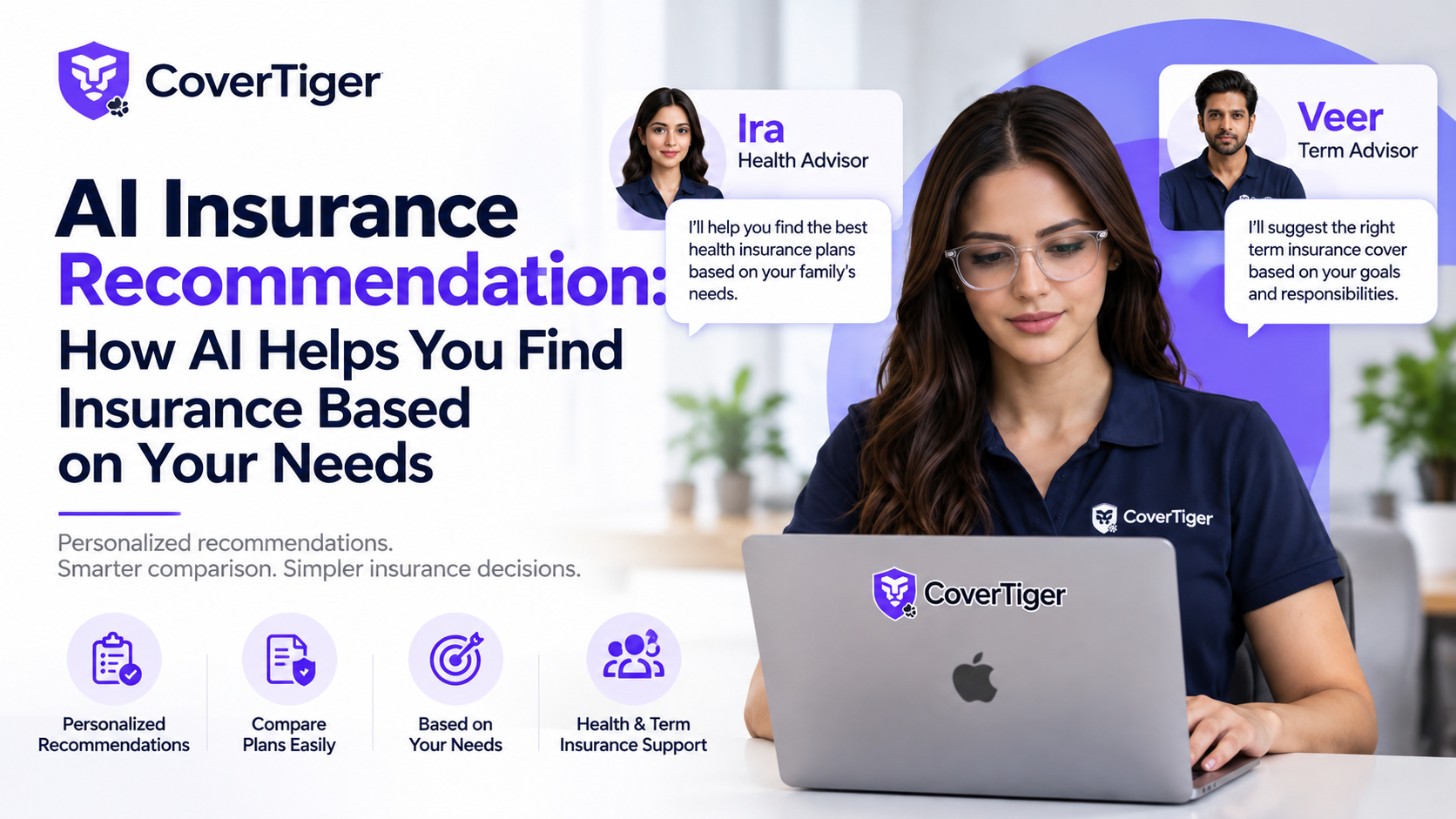
AI Insurance Recommendation: How AI Helps You Find Insurance Based on Your Needs
Choosing an insurance policy is not simply about finding the lowest premium. Buyers may need to compare coverage, policy terms, exclusions, waiting periods, co-payment, deductibles, hospital networks and other conditions.
An AI Insurance Recommendation system can make this comparison easier by understanding a user's requirements and helping identify insurance options that may be relevant to their profile.
Instead of searching through multiple insurance websites manually, an AI Insurance Advisor can help organise information around factors such as age, family structure, financial responsibilities, health requirements, coverage needs and budget.
CoverTiger brings this approach together through its AI advisors Ira and Veer, who help users understand insurance options and compare plans based on their requirements.
How Does an AI Insurance Recommendation Work?
An AI-powered recommendation process generally starts by understanding the user's requirements.
For example, someone looking for health insurance may need to consider:
- Age
- Number of family members
- Existing health conditions
- Desired sum insured
- Location
- Budget
- Hospital preferences
- Waiting periods
- Co-payment
- Coverage requirements
For term insurance, the relevant information can be different. Income, age, dependents, liabilities, financial goals and required life cover can become important inputs.
The AI can then organise the available information and help the user compare relevant policy characteristics.
This is the basic idea behind AI Based Insurance Recommendations: instead of presenting insurance information without context, the system attempts to make the information more relevant to the individual's requirements.
Can AI Recommend Insurance Plans?
Yes, AI can be used to generate insurance recommendations based on information provided by the user and available insurance products.
However, an AI recommendation should be treated as a decision-support tool rather than a replacement for reading the actual policy documents.
According to the IRDAI Insurance Web Aggregator framework, insurance comparisons and product information should be presented accurately and based on relevant information provided by insurers.
That means a useful recommendation should help answer:
Why does this insurance plan match my requirements?
rather than simply saying:
Buy this plan.
What Factors Should an AI Insurance Advisor Consider?
A meaningful AI Insurance Recommendation should consider more than premium.
1. Your Coverage Requirement
The first question should be how much coverage you actually need.
For health insurance, this can depend on family size, age, location and healthcare requirements.
For term insurance, income, dependents, loans and long-term financial responsibilities can influence the required life cover.
2. Your Age and Life Stage
A young individual, a married couple with children and a family supporting elderly parents may have very different insurance requirements.
This is where a Personalized Insurance Advisor AI can be useful. The recommendation can be based on the user's profile rather than a generic list of plans.
3. Existing Health Conditions
For health insurance, existing conditions can affect waiting periods, underwriting and coverage terms.
An AI system can help users identify the questions they need to check, but final eligibility and coverage remain subject to the insurer's underwriting and policy wording.
4. Premium and Affordability
Premium matters, but choosing purely on price can create problems later.
Two policies with similar premiums may have different waiting periods, exclusions, room-rent conditions, co-payment requirements or benefits.
This is why AI Insurance Comparison should look beyond the premium.
You can also use CoverTiger's compare health insurance plans page to understand how different health insurance options can be evaluated.
5. Policy Features
An AI recommendation can help users compare features such as:
- Coverage
- Waiting periods
- Exclusions
- Co-payment
- Deductibles
- Hospital network
- Riders
- Policy tenure
- Premium payment options
The exact features compared will depend on the type of insurance.
AI Insurance Recommendation vs Traditional Insurance Search
The biggest difference is how information is presented.
| Traditional Insurance Search | AI Insurance Recommendation |
|---|---|
| User searches multiple websites | User provides requirements in one interaction |
| Information can be scattered | Information can be organised around the user's needs |
| User manually compares features | AI can help structure the comparison |
| Generic search results | Profile-based recommendations |
| User interprets insurance terminology | AI can explain terminology |
| Manual shortlisting | AI can help create a shortlist |
| User still verifies policy details | User should still verify the final policy wording |
The goal is not to remove the buyer from the decision-making process. The goal is to make the research and comparison process easier.
You can also explore CoverTiger's AI in health insurance content to understand how AI is being applied to health insurance research and comparison.
What Is a Personalized Insurance Advisor AI?
A Personalized Insurance Advisor AI uses information about an individual or family to make insurance information more relevant.
For example:
User A
30 years old, single, ₹10 lakh annual income and no dependents.
User B
38 years old, married, two children, home loan and dependent parents.
Both users may search for "term insurance", but their coverage requirements can be very different.
A personalized system can consider these differences before presenting relevant options.
This is why AI Based Insurance Recommendations can be more useful when they are connected to the user's actual requirements rather than based only on generic popularity or premium.
How AI Can Help With Health Insurance Recommendations
Health insurance is one of the areas where comparison can become complicated because policies can differ across several important conditions.
An AI Health Insurance Advisor can help users organise factors such as:
- Sum insured
- Family members
- Waiting periods
- Pre-existing conditions
- Co-payment
- Room-rent limits
- Network hospitals
- Restoration benefits
- Exclusions
- Premium
Users can explore CoverTiger's health insurance plans to understand the available health insurance category and coverage options.
Meet Ira — CoverTiger's AI Health Insurance Advisor
Ira is CoverTiger's AI Health Insurance Advisor.
Ira can help users understand and compare health insurance options based on their requirements. For families, users can also explore CoverTiger's family health insurance plans while evaluating coverage needs.
Instead of asking only:
"Which health insurance has the lowest premium?"
a user can ask:
"I am 35, married, have two children and want ₹15 lakh coverage. What should I compare?"
That creates a more useful starting point for an insurance comparison.
How AI Can Help With Term Insurance Recommendations
Term insurance requires a different type of assessment.
Factors can include:
- Age
- Annual income
- Existing loans
- Dependents
- Children's education
- Financial obligations
- Desired policy term
- Required life cover
- Health and lifestyle information
Users can explore CoverTiger's term insurance plans when researching term insurance options.
Meet Veer — CoverTiger's AI Term Insurance Advisor
Veer focuses on term insurance.
For example, someone with a home loan, dependent parents and young children may need to evaluate a different level of financial protection from a single person with fewer financial obligations.
The purpose of an AI recommendation is therefore not simply to show a premium. It is to help the user understand why a particular level of coverage or policy structure may be relevant to their situation.
Users can also compare options through CoverTiger's compare term insurance plans section.
AI Insurance Buying Assistant: From Recommendation to Comparison
An AI Insurance Buying Assistant can help throughout the research stage instead of only giving a final recommendation.
For example:
Step 1: "What type of insurance do I need?"
Step 2: "How much coverage should I consider?"
Step 3: "What features should I compare?"
Step 4: "Why is one plan more expensive?"
Step 5: "What exclusions should I check?"
Step 6: "What questions should I ask before buying?"
This makes the AI function more like a Virtual Insurance Advisor than a simple search box.
The buyer can continue asking questions and understand the reasoning behind different comparison factors.
Can AI Compare Insurance Plans?
Yes. AI can help organise and compare insurance plans when relevant product information is available.
For example, an AI Insurance Plan Comparison can place factors such as premium, coverage, waiting periods, exclusions and benefits into a structured comparison.
However, the quality of the comparison depends on the accuracy and freshness of the underlying insurance information.
The IRDAI Insurance Web Aggregator guidelines provide a regulatory reference for insurance comparison and product information.
Therefore, users should always check the latest policy wording and insurer-provided information before purchasing.
How to Choose Insurance With AI
If you are using an AI insurance advisor, follow a simple process.
Step 1: Share Your Requirements
Provide accurate information about your age, family, income, health requirements and financial responsibilities.
Step 2: Define Your Coverage
Decide what you want the policy to protect.
Step 3: Ask AI to Explain the Options
Don't just ask for a recommendation. Ask why certain plans or features may be relevant.
Step 4: Compare Multiple Plans
Use AI Insurance Comparison to compare relevant policy features rather than focusing only on premium.
Step 5: Check the Fine Print
Read exclusions, waiting periods, co-payment, deductibles, limits and other conditions.
Step 6: Verify Before Buying
The final decision should be based on the actual policy documents and information provided by the insurer.
What an AI Insurance Advisor Should Not Do
AI should not be treated as an automatic replacement for policy documents or regulatory information.
A responsible AI Insurance Advisor should:
- Explain its recommendation
- Use relevant user information
- Clearly distinguish facts from assumptions
- Avoid hiding important exclusions
- Encourage users to check policy wording
- Avoid guaranteeing claim approval
- Avoid presenting a recommendation as a universal "best" policy
This is particularly important because insurance policies contain detailed contractual terms.
Why Explainable Recommendations Matter
A recommendation is more useful when the user understands why it was made.
For example:
"This plan has a lower premium."
is not enough.
A better explanation would identify the relevant comparison factors:
"This option has a different waiting period, co-payment structure and hospital network. Here's how those differences relate to the information you provided."
This approach makes an AI recommendation easier to understand and verify.
AI Insurance Recommendation: What Should You Ask?
Before accepting an AI recommendation, ask:
- Why was this plan recommended?
- What alternatives were compared?
- What are the major exclusions?
- What waiting periods apply?
- Are there any co-payment requirements?
- What is the applicable deductible?
- Which hospitals are covered?
- What happens if my requirements change?
- Is the information based on current insurer-provided details?
- Where can I read the complete policy wording?
These questions turn an AI recommendation into a structured research process.
AI Insurance Recommendation With CoverTiger
CoverTiger positions itself as an AI-powered insurance platform where Ira focuses on health insurance and Veer focuses on term insurance.
For health insurance, users can explore CoverTiger's health insurance plans and use Ira to understand available options.
For families, the family health insurance section provides another relevant starting point for evaluating coverage.
For term insurance, users can explore term insurance plans, where Veer is positioned as the AI term insurance advisor.
Users who want to understand the brand and its AI advisor approach can also visit the CoverTiger About Us page.
Frequently Asked Questions
Can AI recommend insurance plans?
Yes. AI can help generate insurance recommendations using information provided by the user and available product information. The recommendation should be treated as decision support, and the final policy wording and insurer terms should always be checked.
How does AI recommend insurance?
An AI system can analyse information such as age, family structure, health requirements, income, liabilities, coverage needs and budget, then help compare relevant insurance options.
Can AI compare insurance plans?
Yes. AI can help structure comparisons across factors such as premium, coverage, waiting periods, exclusions, benefits and other policy conditions when reliable product information is available.
How can AI help me choose insurance?
An AI insurance advisor can help you understand insurance terms, identify relevant comparison factors, shortlist options and explain differences between plans.
Can an AI insurance advisor personalize recommendations?
Yes. Personalization can be based on information such as age, family members, financial responsibilities, health requirements and desired coverage.
Is an AI insurance recommendation enough to buy a policy?
No. Users should verify the recommendation against the insurer's latest product information, policy wording, exclusions, eligibility requirements and applicable terms before purchasing.
What is an AI insurance buying assistant?
An AI insurance buying assistant is a conversational tool that can help users research, compare and understand insurance options during the buying journey.
Final Takeaway
AI Insurance Recommendation can make insurance research more structured by connecting a user's requirements with relevant comparison factors and available insurance options.
The real value is not simply getting an AI-generated answer. It is being able to understand why certain plans may be relevant, what differences exist between them and which policy conditions need closer attention.
For health insurance, Ira can help users explore and compare health insurance options. For term insurance, Veer can help users understand and compare term insurance based on their financial responsibilities and coverage needs.
An AI Powered Insurance Advisor should ultimately help people make a more informed decision—not make the decision for them.