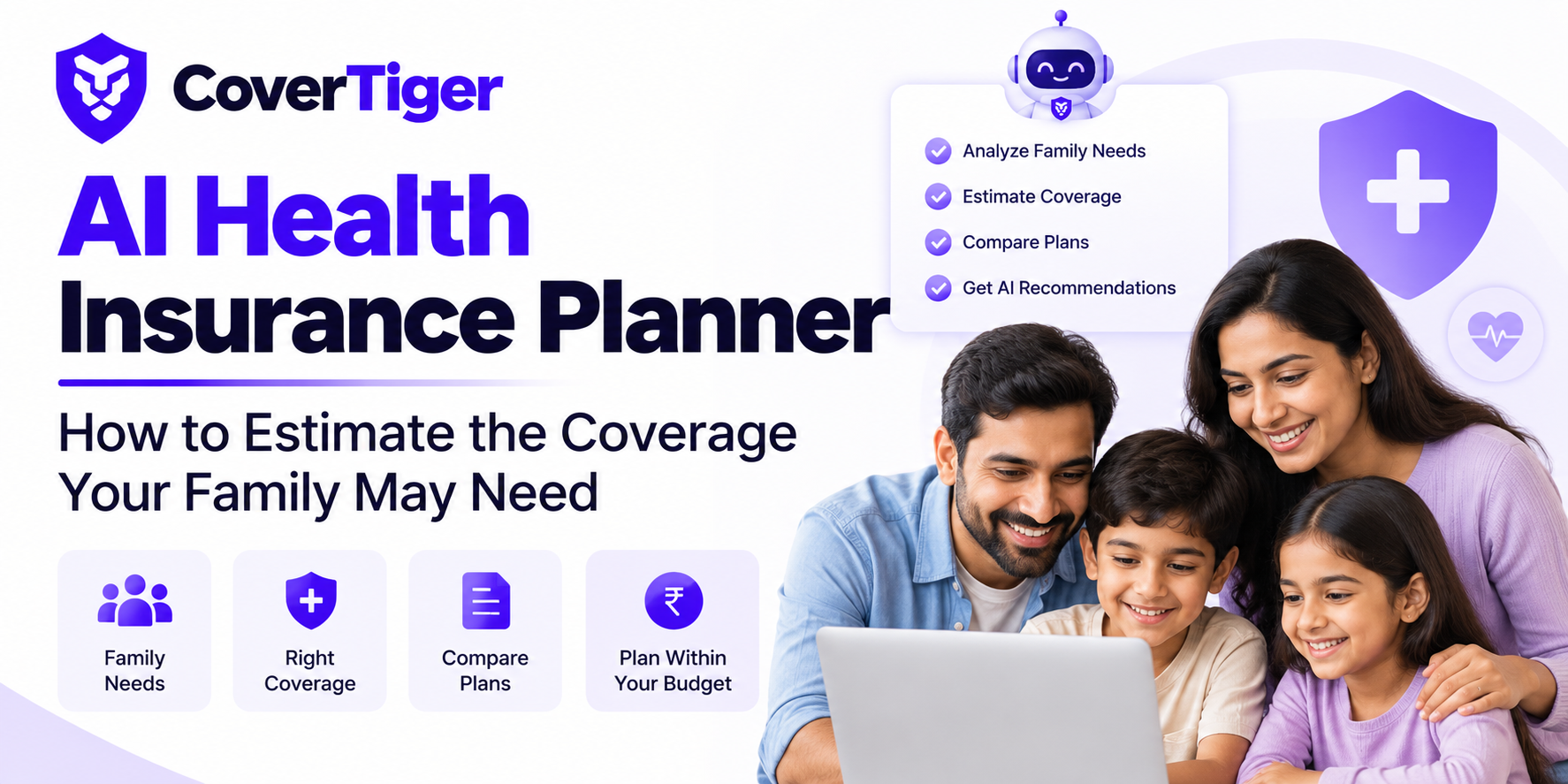
AI Health Insurance Planner: How to Estimate the Coverage Your Family May Need
Choosing health insurance is not just about finding the lowest premium. The right level of cover depends on your family’s medical needs, current insurance, financial responsibilities, preferred hospitals and ability to pay unexpected expenses.
An AI Health Insurance Planner can help organise these details and make it easier to understand the factors that influence a health insurance decision. It can support research and comparisons, but it cannot guarantee that a particular sum insured will cover every future medical expense.
This guide explains how to estimate your family’s health insurance needs, what to check before choosing a policy, and how AI-assisted tools can help you compare options more systematically.
What Is an AI Health Insurance Planner?
An AI Health Insurance Planner is a digital tool that can help users structure information about their household, medical requirements and budget to explore health insurance options.
Depending on its capabilities and the information provided, it may help users:
- List the people who need coverage.
- Consider existing employer-provided or individual health insurance.
- Identify questions about hospital networks and treatment access.
- Compare policy features, limits, waiting periods and exclusions.
- Organise a shortlist of plans for further review.
AI-generated suggestions are only as reliable as the information available to the tool. Always verify policy details against the insurer’s official policy wording and product documents.
Step 1: List Everyone Who Needs Health Insurance
Start by identifying who needs cover. Your requirements may be different if you are buying a policy for yourself, your spouse, children or parents.
Make a simple list that includes:
- Each family member’s age.
- Whether anyone already has health insurance.
- Whether an employer or another organisation provides cover.
- Any specific healthcare access requirements you want to consider.
- Whether you are looking for individual policies or a family floater.
A family floater shares a single sum insured among the covered members, while individual policies provide separate coverage limits for each insured person. Which structure is appropriate depends on your circumstances and the policy terms.
You can review health insurance plans on CoverTiger as part of your research.
Step 2: Review Your Existing Coverage
Before choosing a new policy, understand what you already have. Employer-provided insurance, an individual policy or a family floater may already cover part of your needs.
Check:
- The current sum insured.
- Who is covered under the policy.
- The policy’s renewal date.
- Waiting periods and exclusions.
- Co-payment, deductible and room-rent conditions.
- Whether your preferred hospitals are in the insurer’s network.
- Any restrictions that may affect access to treatment.
Do not assume that employer coverage will always be available. Consider what would happen if you changed jobs or your employer changed its insurance arrangement.
If you already have a policy, review its wording before deciding whether to renew, supplement or replace it. Any change should take account of continuity benefits, waiting periods and the terms of the new policy.
Step 3: Consider Your Family’s Healthcare Needs
There is no single sum insured that is right for every family. Think about the kinds of expenses you want the policy to help cover and the healthcare services available where you live.
Useful questions include:
- Which hospitals would your family prefer to use?
- Are specialist services important for your location or circumstances?
- Would a large unexpected hospital bill create financial difficulty?
- Are there policy limits that could leave you paying a substantial amount yourself?
- Would you prefer broader coverage even if the premium is higher?
Do not share unnecessary sensitive medical details with an AI tool. Provide only the information needed for your comparison, and confirm any medical-history-related requirements directly with the insurer.
Step 4: Estimate a Practical Sum Insured
The sum insured is the maximum amount available under the policy, subject to its terms, limits and conditions. It should be considered alongside the cost of healthcare in your area and your household’s financial capacity.
You can use the following framework to organise your thinking:
- Review local hospital costs: Consider the potential cost of hospitalisation and treatment at facilities your family may use.
- Consider the number of people covered: A shared family floater may be used by more than one member during the policy year.
- Check policy sub-limits: A high headline sum insured may still have room-rent limits, treatment caps or other restrictions.
- Account for existing cover: Review whether current policies provide useful additional protection, while checking their terms and coordination requirements.
- Balance cover and affordability: Choose a premium that fits your budget over time, not just for the first year.
An AI tool can help compare scenarios, but any estimate should be treated as a starting point—not a guarantee of future medical costs or claim payment.
Step 5: Compare Premiums Alongside Policy Features
A lower premium does not automatically mean better value. Compare policies using the same criteria so that you can understand the differences.
| Factor | What to check |
|---|---|
| Sum insured | The total available coverage and how it applies to each member |
| Hospital network | Whether preferred hospitals are available for cashless treatment, subject to insurer rules |
| Waiting periods | How long certain conditions or treatments may be excluded |
| Pre-existing diseases | Disclosure requirements and applicable waiting-period terms |
| Co-payment | The share of eligible expenses you may need to pay |
| Deductible | The amount that may need to be paid before specified coverage applies |
| Room-rent limits | Whether room eligibility or proportionate deductions may apply |
| Exclusions | Treatments, conditions or expenses not covered |
| Renewal terms | Conditions affecting continuation of the policy |
| Claim process | Documents, authorisation requirements and available support |
CoverTiger provides a health insurance comparison resource that can be used as part of the research process. Confirm current benefits and terms in the official documents for each plan.
Step 6: Check Whether a Family Floater or Individual Policies Fit Better
A family floater may offer a shared pool of coverage for several family members. Individual policies provide a separate sum insured for each covered person.
When comparing the two, consider:
- The ages of all family members.
- Whether multiple members may need hospitalisation in the same policy year.
- The cost of separate policies compared with a floater.
- Differences in coverage, exclusions and waiting periods.
- Whether parents or other relatives would be better assessed under a separate policy.
There is no universal answer. Compare the actual policy terms and premium quotations before deciding.
Step 7: Use AI to Organise Your Shortlist—Then Verify the Details
An AI Health Insurance Planner can be useful for turning your requirements into a structured comparison. For example, you could ask it to create a checklist of policy features to review or summarise the differences between policy documents you provide.
For a more useful comparison, specify the information you want assessed, such as:
- Who needs coverage.
- Your approximate annual premium budget.
- Preferred hospitals or service locations.
- The sum insured you want to compare.
- Important policy conditions you want to understand.
Ask the tool to distinguish confirmed policy wording from information it cannot verify. Check all important details directly with the insurer before buying.
CoverTiger’s Ira — Health Advisor can be presented as a resource for exploring health insurance options and understanding factors to compare. An AI advisor should support informed research, not replace the insurer’s official documents or guarantee that a plan is suitable.
Common Mistakes to Avoid
Choosing Only by Premium
A cheap policy may have limits or exclusions that do not match your needs. Compare coverage and conditions, not just price.
Assuming the Sum Insured Covers Every Expense
The sum insured is subject to policy terms, exclusions, sub-limits, deductibles and co-payments. Review these details before buying.
Ignoring Waiting Periods
Some conditions and treatments may be subject to waiting periods. Understand these before selecting a policy.
Forgetting to Disclose Required Information
Answer the insurer’s application questions accurately and disclose information as required by the proposal form and policy process. Incorrect or incomplete disclosures can create claim complications.
Treating AI Suggestions as a Guarantee
AI tools can misinterpret policy wording or rely on outdated information. Confirm important details against current official documents and ask the insurer for clarification where needed.
Frequently Asked Questions
What is an AI Health Insurance Planner?
It is a digital tool that can help users organise household requirements, compare policy features and prepare questions before choosing health insurance. Its capabilities vary, and its suggestions should be verified.
How much health insurance does a family need?
There is no single amount suitable for every family. Consider local healthcare costs, the number and ages of covered members, existing coverage, policy restrictions and your budget. Compare available options before deciding.
Is a family floater better than individual health insurance?
It depends on the family’s circumstances and the specific policies. A floater shares a sum insured, while individual policies provide separate limits. Compare premiums, benefits and conditions for both structures.
Can AI calculate the exact health insurance coverage I will need?
No tool can reliably predict every future medical expense. AI may help organise estimates and compare scenarios, but its results are assumptions rather than guarantees.
Can AI compare health insurance exclusions and waiting periods?
An AI tool may help summarise policy wording if it has access to the relevant documents. Always verify the summary against the insurer’s current policy wording, especially for exclusions, waiting periods and claim conditions.
Should I replace my existing health insurance policy?
Do not switch based only on a lower premium. Review continuity benefits, waiting periods, exclusions and the new policy’s terms. Confirm how a change could affect your coverage before making a decision.
Final Takeaway
Estimating your family’s health insurance needs starts with understanding who needs coverage, what protection you already have, the healthcare access you want and the policy conditions that could affect a claim.
An AI Health Insurance Planner can help organise these details and make comparisons easier. The final decision should still be based on verified policy documents, clear understanding of exclusions and limits, and a premium you can reasonably maintain.
Explore CoverTiger’s health insurance plans and compare relevant features before making your decision.